Home | Hazard | Partner | Junior | Basic
|
|
Tennis isn’t all about hitting your groundstrokes and returning the shots. The tennis game requires two critical
elements, one is the physical aspect in which you have to be in good shape and be able to hit the strokes
and the other is about the mental aspect.
Therefore, to play winning tennis, your knowledge must be broad and thorough. Mastery of the mind is the crucial factor that tips the balance in favor of the winner.
Co-ordination Skills - Eye - Body - Brain, is the way we want to have our co-ordination
and skills. Unfortunately many of us see the ball, and our body takes too long to react to it passing us. This area can be
improved by developing what is called your motor skills, so that you see the ball, and your body automatically positions itself
in the correct place.With a complete variety of situations you can be in for a ball to pass you, you need to work on improving
your total body, to react as one fast efficient machine.
Start taking lessons early. These skills will help you for the rest of your lives. Our goal is not to turn you into a professional, but to give you the tools for success
that will make the game more enjoyable.
There are no hard and fast rules for learning to play tennis or for developing your game, and there is no one style which
could be laid down as the "correct" way to play. Your own style could be one of the most important decisions you willl make
in tennis. You should take great care in deciding on which champion you should model your strokes and your natural approach
to the game; you should give much thought to deciding whether to change any stroke which may feel natural; and you should
be wary of any coach who tells you there is only one way to make certain strokes or only one way to play certain shots.
Fundamentals are necessary for cutting down on injuries and increase longevity in the game.It appears that the more skillful the player, the more enjoyment is gained.
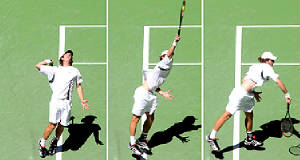
Which muscles and joints are involved in the tennis stroke or swing? Well, a safe answer would be all of them. Next time
you watch someone swing a tennis racket, take notice of how many joints are moving; practically every joint in the body works
at some point during a tennis stroke, making it a very complex movement. To appreciate the neuromechanical challenge a tennis
stroke places on the body, lets look at some of the basic biomechanical requirements.
Tennis requires full rotational capacity of nearly every joint involved. tennis is a rotation sport; to reach your tennis
potential, you must be able to repeatedly rotate efficiently and explosively.
Consider a known physical principle; force applied to an object imparts to it an acceleration, not only in translation
but also in rotation; the object turns around its centre of gravity. This is important, as rotation may cause the affected
vertebrae to displace from the normal position; chiropractors and osteopaths refer to the misalignment of such vertebrae as
subluxation.
Tennis players with inadequate postural alignment, muscle imbalance syndromes, and associated joint motion restriction
will not be able to rotate efficiently. This was proven by Moshe Feldenkrais who, in comparing humans and animals, calculated
mathematically the moment of inertia of the body around the vertical axis.
Feldenkrais noted that when animals adopt a bipedal stance, the head leans forward and is balanced by the pelvis protruding
backward. The result is that the moment of inertia around the vertical axis is four to five times greater than humanlike vertical
alignment.
|






|
|
|
|||||||||||||||||||||||||||||||||||